about eiga
European Industrial Gases Association
The European Industrial Gases Association, EIGA, is a safety and technically oriented organisation representing the vast majority of European and a number of non-European companies producing and distributing industrial, medical and food gases.
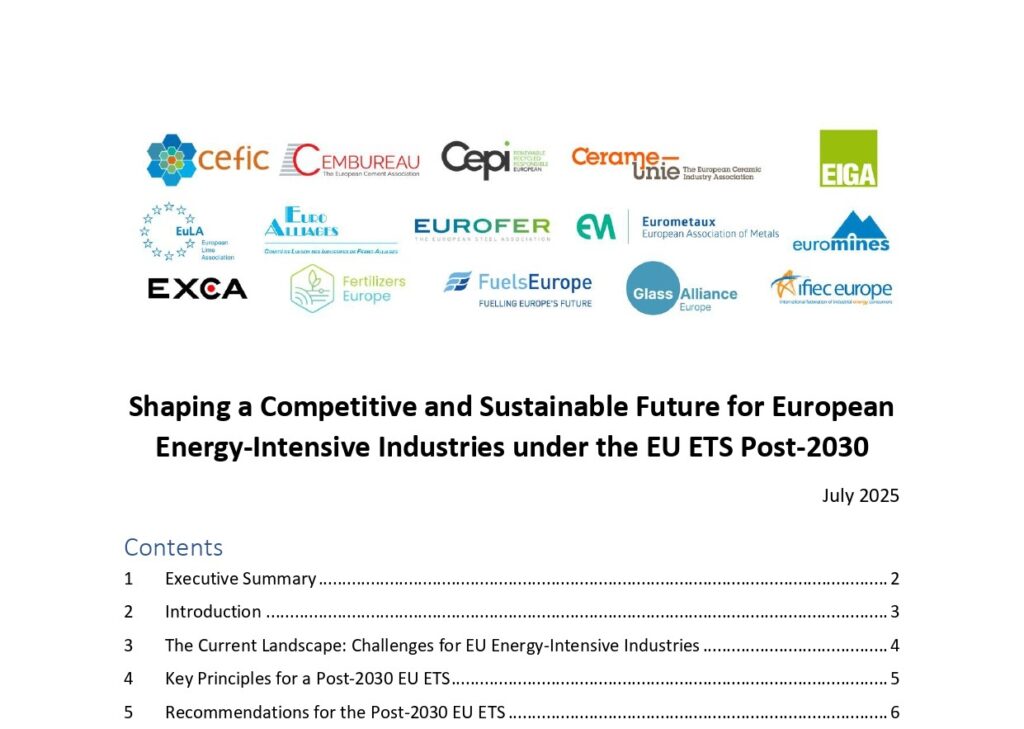
Energy Intensive Industries: do they have a future in Europe?
The Alliance of Energy Intensive Industries issued recommendations in advance of the review of the EU Emissions Trading System (EU ETS):
Strengthened Carbon Leakage Protection: ensure robust prot...
Read more

2024 Facts & Figures about Industrial Gases
They are invisible, so you don’t see them. Nevertheless, you all know and use our products. It would be difficult not to, they are used everywhere: in manufacturing, chemicals, metals, food, electro...
Read more

EIGA Summer Summit 2025
It's a wrap! The EIGA Summer Summit 2025 is closed.
EIGA Members met in Edinburgh on 30 May 2025 for the Annual General Assembly Meeting.
The evening was a celebration of the achievements of the...
Read more
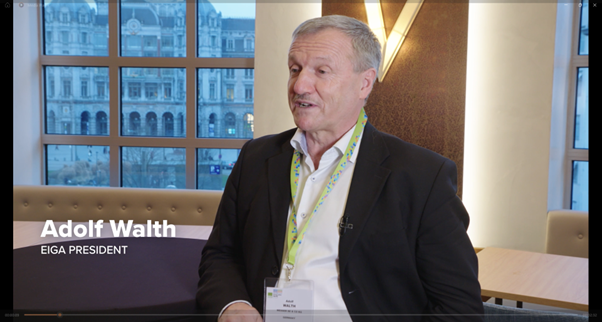
What trends or developments in the Industrial Gases industry will most impact the coming years?
Watch the exclusive interview of EIGA's President, Adolf Walth....
Read more
documents
Latest Publications
Document
DOC 238 / 22 - Prevention of Plant Instrument and Utility Gas System Cross Contamination
This publication applies to HYCO plants and provides design and safeguards requirements of utility and instrument gas systems. It identifies the potential hazards resulting from the connections between gases, instrument gases, and the process.
DownloadCommunication
COM 15 / 25 - The Role of the European Industrial Gases Sector for the European Economy - A study in the context of the evolving Carbon Leakage Protection for the European Industrial Gases Association (EIGA)
The EU-27 industrial gases (IG) sector (NACE 20.11) which covers the outsourced supply side of industrial gases, generated €21.2bn in revenue and €7.9bn in value added and directly employed c.40,100 people in 2024. Although modest in size relative to total manufacturing, upstream and induced linkages expand the footprint to €51.2bn in revenue, €21.0bn in value added and c.190,200 jobs in 2024. Industrial gases producers purchase a wide range of inputs (beyond electricity), and these flows propagate along EU value chains.
This study assesses level-playing field issues in the context of carbon-leakage protection. This has two dimensions: externally, it concerns the position of EU industries vis-à-vis non-EU competitors; internally, it concerns competitive neutrality within the EU – here, in particular, between insourced and outsourced IG production.
DownloadSafety Information - Transport Safety
SI-TS 18 / 25 - Defensive Driving
Defensive driving is an approach to driving that emphasizes safety and proactive decision-making. It entails maintaining constant awareness of the surroundings, anticipating potential hazards, and taking necessary precautions to prevent accidents. When implementing defensive driving techniques, drivers remain focused and attentive, carefully surveying the road for any risks and adjusting their driving behaviour accordingly. They prioritize maintaining a safe distance from other vehicles, complying with traffic laws and speed limits, and avoiding distractions that could divert their attention. Defensive driving also involves recognizing one's own driving limitations and actively seeking opportunities for skill improvement through education and training.
Download